Stewardship in Action at Idler's Rest Nature Preserve
What is Happening at Idler’s Rest?
In late June 2026, Palouse Land Trust will begin a forest stewardship project along a small section of the Highland Loop at Idler's Rest Nature Preserve. This work addresses a localized area of Douglas-fir affected by Armillaria root rot and marks the beginning of a longer-term effort to improve forest health, enhance wildlife habitat, and support a more resilient future forest.
This page will serve as a hub for project updates, background information, and answers to frequently asked questions.
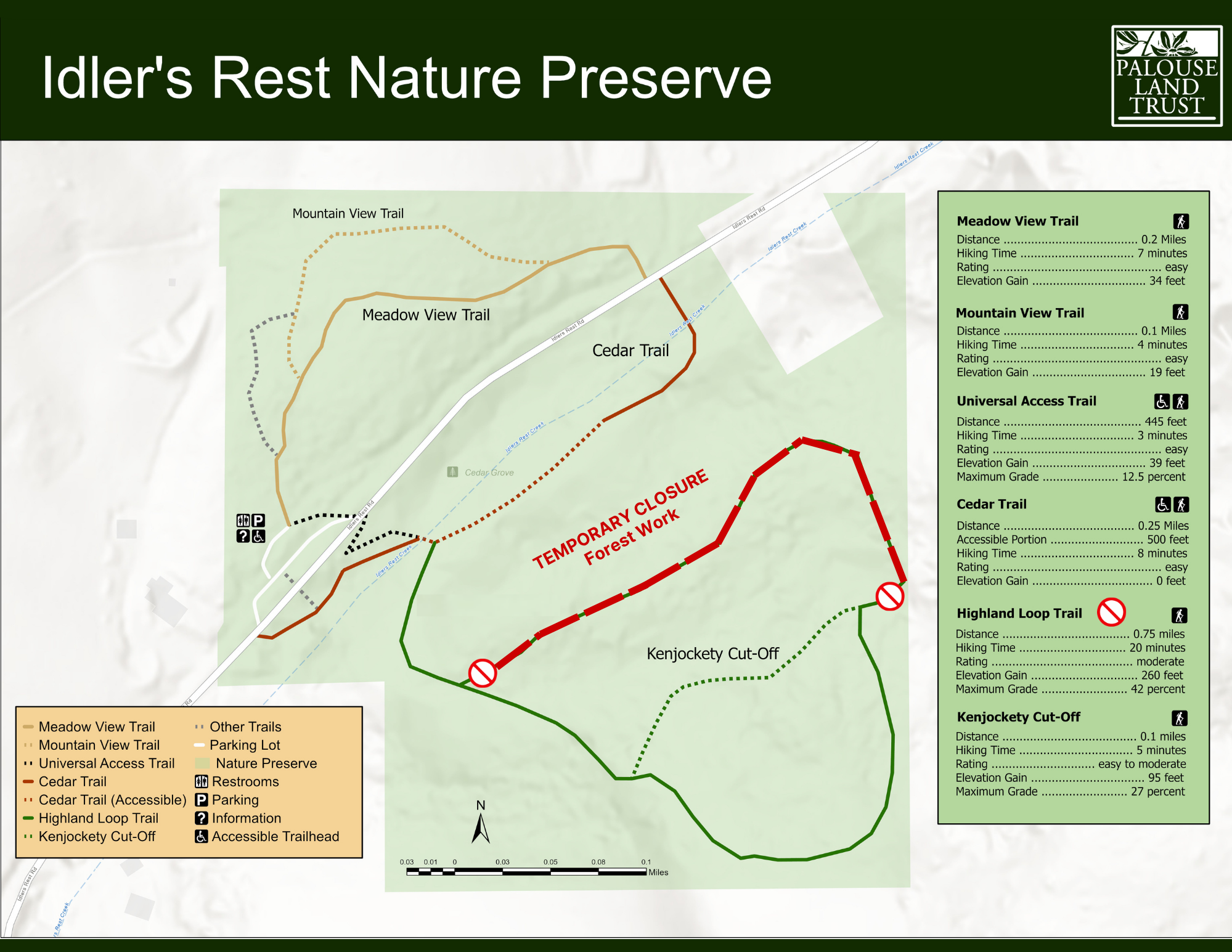
Temporary closure still in place along part of highland loop
Updates
The closed section of Highland Loop is currently undergoing work in preparation for reopening (Updated 10.1.26)
the cedar trail and highland loop will be closed on tuesday, August 11th-13th as IDL helps remove downed trees for firewood. The section of highland loop trail is still temporarily closed for the time being (Updated 8.7.26)
Due to ongoing trail clearing, a section of the Highland Loop Trail remains temporarily closed. The remainder of the Highland Loop Trail and the Kenjockety Cutoff are open and clear for visitor use. We appreciate your patience as we work to safely reopen the closed section as soon as possible. (Updated 7.31.26)
the cedar trail and highland loop will be closed every monday and Tuesday through the end of July. Due to these trees being close to our most popular trails, visitor safety is our top priority. (Updated 7.10.26)
Part of highland loop trail will be closed July 10 while our partners at Idaho Department of Lands continue to remove affected trees. (Updated 7.8.26)
Idlers rest will be closed June 29 - June 30 while our partners at Idaho Department of Lands safely remove trees affected by disease along Highland Loop Trail. (Updated 6.23.26)
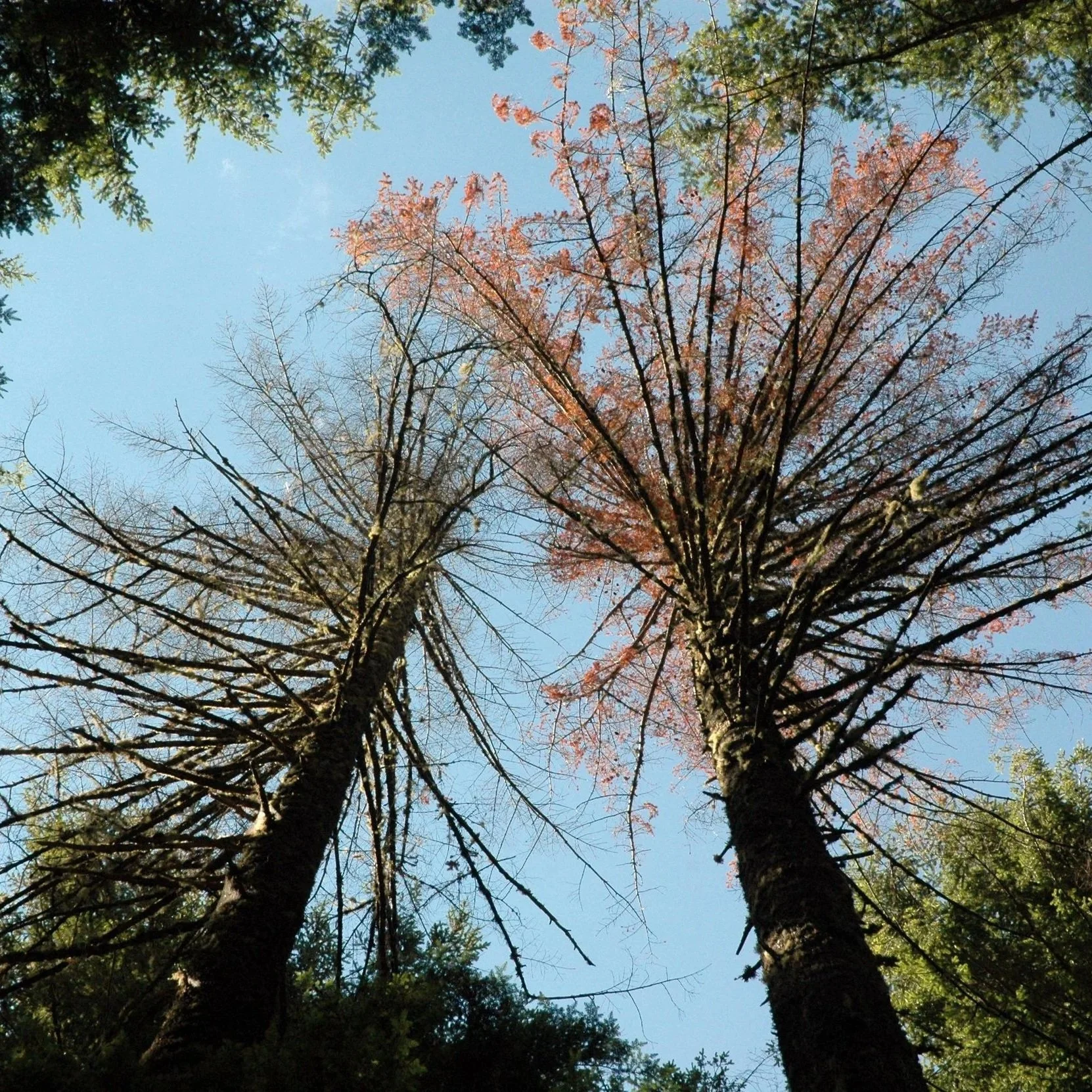
The visual toll of root rot: One tree completely stripped, while its neighbor turns a warning shade of red
Why Is This Work Needed?
Over the past several years, a concentrated group of Douglas-fir trees along the Highland Loop has been affected by Armillaria root rot (Armillaria ostoyae), a naturally occurring fungus found throughout forests of the Inland Northwest.
Armillaria spreads through underground root systems, gradually killing trees and creating pockets of dying forest. While the fungus can infect a massive range of hosts, Douglas-fir are highly susceptible, making them the primary targets of this particular outbreak. Left unmanaged, the disease will keep spreading to neighboring trees, wiping out the Douglas-firs and fundamentally changing the makeup of the woods. While Armillaria is natural, concentrated outbreaks can severely threaten overall forest health, reducing tree diversity and making it harder for new, desirable species to grow. Learn more about Armillaria root rot HERE
"Root rot has fundamentally changed this forest stand over time. This project gives us an opportunity to guide the area through that transition while maintaining habitat and establishing a forest that can thrive for decades to come." - Craig Malone: PLT Community Lands Steward
Frequently Asked Questions (FAQs)
We understand that seeing trees removed from a beloved preserve can raise questions and concerns. Below are answers to some of the most common questions we have received about the Highland Loop forest stewardship project.
1) Will healthy trees be impacted?
Healthy trees are not the focus of this project. Forestry professionals from the Idaho Department of Lands have worked with Palouse Land Trust to identify trees that pose a safety concern due to disease-related decline. Healthy trees, including ponderosa pine, will remain. Unfortunately, “Approximately 90% of the overstory Douglas-fir in this stand have died or are in decline due to Armillaria and laminated root rot.” - Robbie Easley: IDL Program Manager
2) What will happen to the trees after?
The felled trees will remain on-site. Rather than being removed from the preserve, felled trees will be retained as nurse logs and coarse woody debris. These logs provide habitat for wildlife, support fungi and insects, retain moisture, reduce erosion, and slowly return nutrients to the soil as they decompose. As restoration work continues, some of these nurse logs will also be used to support future tree plantings. Learn more about nurse logs HERE
3) Why not just let nature take its course?
Armillaria root rot spreads underground through root-to-root contact and can persist in the soil for decades. Because Douglas-fir are more susceptible to this disease, infected trees can serve as a source of continued spread to nearby Douglas-fir through interconnected root systems. By removing only dead and severely declining trees, we can help create conditions for new growth while supporting a more diverse and resilient forest.
4) Who is doing the work?
The project is being completed by the Idaho Department of Lands (IDL) in partnership with Palouse Land Trust (PLT). IDL brings extensive forestry expertise and experience managing forest health projects throughout Idaho. We are grateful for their partnership and support in helping care for the preserve.
5) How are you planning for the future of this forest?
Our goal is to establish a more diverse and resilient forest by replanting with a mix of native species, including ponderosa pine and Western larch. Increasing species diversity helps create a forest that is better able to withstand disease, drought, and other environmental stressors while providing a wider range of habitat for wildlife.
This approach is especially important because Armillaria root rot is likely to remain present in the soil and root systems of this area for many years. Since Douglas-fir is particularly susceptible to the disease, allowing the site to regenerate naturally could result in new Douglas-fir becoming infected as they establish. By introducing a broader mix of native species, we can help reduce future vulnerability to Armillaria and set the forest on a healthier trajectory for generations to come.
6) What comes next?
This project is the first step in a longer-term restoration effort. As conditions allow, Palouse Land Trust hopes to engage volunteers and community members in future stewardship activities that may include: brush reduction and fuel management, native tree replanting, habitat enhancement, monitoring forest recovery, and ongoing trail or preserve stewardship
7) How can I stay informed?
Project updates, photos, and reopening information will be shared through Palouse Land Trust's website, email newsletter, and social media channels. If you have additional questions, please contact:
Craig Malone Lovina Englund
Community Lands Steward Executive Director
craig@palouselandtrust.org lovina@palouselandtrust.org
208-298-9014 208-669-0722
A Final Note
We know that every tree at Idler's Rest matters to someone. We share that appreciation. This project is being undertaken thoughtfully, with guidance from forestry professionals and with a commitment to balancing visitor safety, ecological integrity, and the long-term health of the preserve.
Thank you for your care, curiosity, and stewardship of this special place.